Anjouan Casino Licence in the UK: What It Means
 Available in GB

An Anjouan licence does not authorise gambling in the UK, and offshore sites do not provide the UKGC safeguard framework.
Table of Contents
- What an Anjouan Licence Does—and Does Not—Authorise
- Anjouan Licensing Without the UKGC Safeguard Framework
- How Anjouan Fits into the Non-UK-Regulated Casino Market
- Bonuses, Payments and the Conditions Behind the Headline
- The UK Legal Position: Operators and Players Are Treated Differently
- Casino Sites: Payout Delays and Verification Are Part of the Risk
- What a New Anjouan Casino Launch Cannot Prove
- Crypto Payments and the Credit-Card Rule
- Reading Casino Reviews When Complaints Have No UK Route
- Offshore Licensing Leaves Safeguards Uneven
What an Anjouan Licence Does—and Does Not—Authorise
An Anjouan casino licence is not a universal permission to offer gambling wherever a website can be opened. Its authority is bounded: it does not authorise operation in the United Kingdom, and it does not override restrictions applying in other listed markets. The distinction matters because a licence may be genuine within its own jurisdiction while still being insufficient for a business that wants to serve customers elsewhere.
I have seen licensing language treated as though it were a passport. It is not. A regulator’s approval is tied to the authority that issued it and the markets in which the operator is permitted to act. A casino displaying an Anjouan licence cannot turn that document into UK authorisation simply by making its website available to people in Britain.
That is the boundary behind searches for an Anjouan casino licence in the UK in 2026. The relevant question is not whether a site has a licence from Anjouan, but whether that licence permits the site to supply gambling services in the British market. It does not. Operators serving customers in Great Britain need a licence from the UK Gambling Commission, wherever the operator itself is based.
When considering an Anjouan-licensed casino for play in the UK in 2026, check that its licensing and availability suit your needs. The payout speed listed here is one practical detail to consider.
1. BeOnBet
Payout speed: 1-3 business days BeOnBet lists a payout speed of 1–3 business days.
2. Dieselwin
Payout speed: 1-3 business days Dieselwin lists a payout speed of 1–3 business days.
3. Revery Play
Payout speed: 1-3 business days Revery Play lists a payout speed of 1–3 business days.
4. Britsino
Payout speed: 1-3 business days Britsino lists a payout speed of 1–3 business days.
5. Jetsetspins
Payout speed: 1-3 business days Jetsetspins lists a payout speed of 1–3 business days.
6. Zombillion
Payout speed: 1-3 business days Zombillion lists a payout speed of 1–3 business days.
7. SpinFormula
Payout speed: 1-3 business days SpinFormula lists a payout speed of 1–3 business days.
8. NightWin
Payout speed: 1-3 business days NightWin lists a payout speed of 1–3 business days.
9. SlotoSport
Payout speed: 1-3 business days SlotoSport lists a payout speed of 1–3 business days.
10. Chanze
Payout speed: 1-3 business days Chanze lists a payout speed of 1–3 business days.
The location of the business does not change that requirement. A company operating from outside Great Britain is not exempt from UK licensing because its offices, ownership or technical operations sit elsewhere. The test is the market the operator serves, not the address it puts on its website. Anjouan approval and UK Gambling Commission approval are separate permissions, issued by different authorities for different purposes.
This is where “international licence” can become a misleading label. It may sound as if one regulator has approved a casino for use across borders. In practice, the description does not establish that the licence covers every country, or that another country’s rules have been satisfied. A casino can be licensed by Anjouan and still lack permission to operate in Britain. A broad-sounding badge does not expand its legal reach.
The same point applies to phrases such as “licensed casino” or “regulated site”. Those words need a jurisdiction attached to them. An Anjouan-licensed casino is licensed in relation to Anjouan’s authority; that wording does not say the UK Gambling Commission has approved it. When marketing collapses those two ideas into one, the useful detail disappears. The name of the issuing regulator is not a decorative footnote.
For online casinos licensed in Anjouan, the practical boundary is therefore straightforward: the licence cannot be relied on as permission to serve Great Britain. A site might still be technically accessible from a British connection, but accessibility is not the same thing as authorisation. Nor does the presence of a registration form or a cashier establish that the operator holds the local permission required to serve that market.
UK casino app guide: games, payments and app types
I would read any claim about an Anjouan online casino licence in two separate parts. First, identify the authority the operator says issued it. Then ask whether that authority’s licence permits the operator to serve the market in question. The first answer does not supply the second. In this case, the UK boundary is explicit: an Anjouan licence does not authorise operation in the United Kingdom.
That distinction is easy to miss because casino websites often present the licence as a single trust signal. A seal, certificate or line in the footer can look conclusive when viewed quickly. But the information only has meaning within its jurisdictional limits. It does not displace the UK requirement for a UK Gambling Commission licence when an operator serves customers in Great Britain.
This is not a technical distinction for lawyers alone. It changes what the licence represents in the site’s relationship with the UK market. Treating an Anjouan permit as interchangeable with a UK Gambling Commission licence gives the wrong impression of the operator’s authority. The two should not be described as equivalent, and one cannot stand in for the other.
The scope is narrow. An Anjouan licence may identify the regulator under which a casino claims to operate, but it is not a UK operating licence and does not authorise British-market service. That is the point to keep in view when the branding suggests otherwise. A licence has borders.
UK Operation
An Anjouan casino licence does not authorise operation in the United Kingdom; operators serving customers in Great Britain must hold a licence from the UK Gambling Commission.
Anjouan Licensing Without the UKGC Safeguard Framework
A licence can establish that an operator has entered a regulatory framework without making every protection familiar from the UK system a condition of that licence. That distinction matters with an Anjouan casino licence. The central issue here is not where a site may offer gambling, but what the licence requires behind the scenes—and what it does not promise about game checks, financial oversight or customer balances.
Anjouan’s framework does not mandate independent random-number-generator testing, audits or the segregation of player funds. Those are three separate gaps, with different practical consequences. They should not be compressed into a general claim that a casino is either “safe” or “unsafe”. The useful question is narrower: which controls are required, which can be verified, and what happens if the operator runs into trouble?
Game fairness is not established by the licence alone
Random-number-generator testing is intended to examine whether game outcomes are produced as designed rather than manipulated. Under the Anjouan framework, such testing is not a licensing requirement. That does not prove that a particular casino’s games are unfair, or that no operator chooses to commission testing voluntarily. It means the Anjouan licence itself is not a guarantee that this check has been carried out.
The distinction is easy to lose in casino branding. A site may display a licence badge beside language about fairness, but the badge and the claim do not necessarily answer the same question. The licence identifies a regulatory basis for the operator; it does not, on its own, certify each game or show that an independent laboratory has examined its random-number generator.
Casino Without a UK Licence: Rules and Risks
In practice, I treat a claim of testing as a separate claim that needs its own evidence. A logo, a general statement about “trusted games” or the presence of familiar titles is not proof of an independent test. And where the framework does not require testing, there is no reason to infer that every licensed casino has completed it. The boundary is simple. Licence is not test.
No mandatory audit requirement
The same care applies to audits. Anjouan’s framework does not make audits a mandatory condition. That is not evidence that every operator has weak accounts or that no casino undergoes any review. It does mean that an audit cannot be assumed merely because the site holds an Anjouan licence.
An audit can serve different purposes, and the word alone may leave important questions unanswered: what was examined, who performed the work, and whether the review covered the issue being claimed. Where a licence does not mandate audits, the licence itself cannot fill those details in. A polished compliance page may describe a company’s own practices, but that is different from a requirement imposed through the licensing framework.
This is where broad assurances can do more work than the underlying controls. “Regulated” can sound like a complete description of oversight; in reality, the scope depends on the rules attached to the particular licence. For casinos licensed in Anjouan, the absence of a mandatory audit requirement is a reason not to treat the licence as proof of an independently reviewed financial position. It is not a finding about any one operator’s books.
Licensing Gaps
Anjouan’s framework does not mandate independent random-number-generator testing, audits, or the segregation of player funds.
Player funds and operator failure
The most direct financial consequence concerns the handling of customer balances. Anjouan’s framework does not require player funds to be segregated from an operator’s own money. Nor does an Anjouan-licensed casino guarantee, simply by holding that licence, that balances are kept separately.
Segregation matters because it can distinguish customer money from operating funds if a business fails. Without a guarantee of separation, a player’s balance may not be ring-fenced from the operator’s assets. If the operator fails, players are unsecured creditors. That describes their position in the failure; it does not mean that every casino will fail, or that a balance will necessarily be lost. It does mean there is no assured separate pool of player funds established by this framework.
That distinction is more concrete than a general warning about “risk”. A balance shown in an account is a claim against the operator, not proof that the same amount is held separately for that customer. When the business remains solvent, the distinction may stay out of sight. If it cannot meet its obligations, it becomes central.
What the licence can and cannot tell a player
For an Anjouan-licensed casino, the licence should not be read as a certificate covering every layer of protection. It does not, by itself, confirm RNG testing, a completed audit or segregated funds. Equally, the absence of those requirements does not prove that an individual operator has never adopted any of those measures voluntarily. Those are separate propositions.
Safe Online Casinos in the UK: What to Check
I have seen licensing language carry more weight in advertising than it can support. A badge may be genuine and still tell only a limited story. The sensible reading is to separate the existence of a licence from evidence about specific controls, and to avoid turning an unrequired safeguard into an assumed one. No inference by association.
That is the practical limit of the framework: it does not make those checks or fund arrangements mandatory, and the licence alone cannot stand in for them.
How Anjouan Fits into the Non-UK-Regulated Casino Market
A non-UK-regulated casino is an online gambling site that operates without oversight from the UK Gambling Commission. The label describes the site’s relationship with the British regulator; it does not, by itself, tell how the site is licensed elsewhere. A casino may sit outside the UKGC system while holding a licence issued by another jurisdiction.
That distinction matters because “non-UK-regulated” is a broad category, not the name of a single licensing model. Sites in it may be licensed by Malta, Curaçao, Gibraltar or Anjouan. Those jurisdictions appear in the same general market description, but their names are not interchangeable, and the category does not imply that every operator has the same regulatory arrangements.
Anjouan is one of the jurisdictions that may license online casinos operating outside the UKGC framework. So, when a site describes itself as an Anjouan-licensed online casino, the description identifies the jurisdiction associated with its licence. It does not mean that the UK Gambling Commission supervises the site. The word “licensed” needs its subject attached: licensed by whom, and for which market?
This is where the language used by casino brands can blur a useful distinction. “International” sounds expansive, while “licensed” sounds like a complete quality statement. Neither tells the whole story. A foreign licence and UKGC oversight are separate things. In practical terms, a site can belong to the wider licensed gambling market and still be non-UK-regulated.
Malta, Curaçao, Gibraltar
Other jurisdictions that may license online casinos operating outside the UKGC framework.
Anjouan
A specific licensing jurisdiction for online casinos that do not operate under UKGC oversight.
UK Gambling Commission
The sole authority responsible for supervising and licensing gambling services within the British market.
I have seen that distinction get lost when operators describe themselves in a way that foregrounds the existence of a licence but leaves its jurisdiction in the background. The licence is not a universal badge. It belongs to a particular regulatory setting. Anjouan is therefore best understood as one possible licensing jurisdiction within a wider group of online casinos that do not operate under UKGC oversight.
One market label, several licensing jurisdictions
The same broad category can include casinos licensed in Malta, Curaçao, Gibraltar or Anjouan. This grouping is useful for describing their position relative to the UKGC, but it should not be read as a claim that the jurisdictions have identical rules, processes or standards. The shared feature in this context is narrower: these casinos are not overseen by the UK Gambling Commission.
That point also helps explain why the phrase “non-UK-regulated casino” is more precise than treating all such sites as simply unlicensed. Some may hold a licence outside the UK. The absence of UKGC oversight does not establish that a site has no licence at all; it establishes that the UK regulator is not the authority supervising it.
Anjouan online casinos belong within this wider category when they operate without UKGC oversight. Their jurisdictional label can help identify the kind of licensing claim being made, but it should not be mistaken for a statement about the site’s UK regulatory status. These are separate pieces of information, even when marketing puts them in the same sentence.
Online casino Malta MGA licence in the UK: explained
The reverse is also true: a site’s appearance in a list of foreign-licensed casinos does not establish that the UKGC regulates it. The regulator named on a licence claim matters. So does the distinction between a regulator’s jurisdiction and the market a casino serves. “Licensed elsewhere” and “UKGC-regulated” are not alternate phrasings for the same condition.
What the Anjouan label tells the reader
The label gives a starting point for identifying the licence jurisdiction attached to a casino. It does not rank the site against operators licensed in Malta, Curaçao or Gibraltar, and it does not establish that all Anjouan-licensed sites share the same ownership, products or operating practices. The category is a map, not a verdict.
That is why broad claims about “the best Anjouan online casinos” can be misleading if they treat the jurisdiction as enough to settle the comparison. A licence label alone does not describe every feature of an individual operator. Two casinos associated with the same jurisdiction may still differ in how they present their services and what they offer. The label groups them by licensing context, not by a complete account of how they operate.
For the same reason, “Anjouan online casino” is a useful shorthand only when it is understood as a casino associated with an Anjouan licence. It should not be used as though it means a casino approved by the UKGC or as a general synonym for every non-UK-regulated site. Some casinos in the broader category may be licensed by other jurisdictions instead.
Do
- Check which jurisdiction is named on the licence claim
- Verify if the site is under UKGC oversight
Don’t
- Mistake a foreign licence for UKGC approval
- Assume “international” means a site is regulated in all countries
In my experience, the clearest way to read these descriptions is to keep two questions separate: which jurisdiction is named on the licence claim, and whether the site is under UKGC oversight. The first places a casino within the wider international licensing landscape. The second identifies its position in relation to the British regulator. One does not answer the other.
Anjouan is part of that landscape, alongside other jurisdictions commonly associated with online casinos outside UKGC oversight. The term “non-UK-regulated” describes the regulatory relationship; “Anjouan-licensed” identifies a possible licensing jurisdiction. Keeping those meanings apart prevents a foreign licence from being mistaken for UKGC approval. Short distinction.
Bonuses, Payments and the Conditions Behind the Headline
A welcome bonus is not simply extra money in an account. It is an offer with conditions attached, and the headline figure says little about how much of it can be withdrawn. In the terms, the key distinction is what must be wagered and which part of the offer the requirement applies to. That wording changes the practical value.
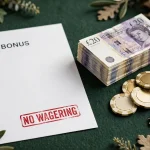
A specialist review has reported offshore welcome offers with wagering requirements of 35x or more. The figure should be treated as an example found in a review, not as a fixed rule for every Anjouan casino bonus. A separate specialist review describes a 40x requirement, with the calculation applying variously to the bonus and deposit together, to the bonus alone, or to the bonus and free spins as a package. Those are materially different calculations. A requirement tied to the combined deposit and bonus can create a larger qualifying balance than one applied only to bonus funds.
VPN-Friendly Casinos in the UK: Access and Risks
The small print decides which interpretation applies. It may also define which games count towards wagering, how long an offer remains available and what happens if the conditions are not completed. Those details are offer-specific; the headline cannot settle them. “Generous” is a sales description. The calculation is the substance.
Free spins are not necessarily free cash
Free spins can carry their own conditions, separate from the welcome bonus. A specialist review reports examples where winnings from spins must be wagered 30–50 times before withdrawal, with caps of £5–£50 on the amount that can be cashed out. The range is reported rather than universal, and the applicable cap and requirement depend on the offer’s terms. A balance displayed after a spin is therefore not necessarily a balance available to withdraw.
Expiry matters too. A specialist review reports free-spin packages with expiry periods of 24–72 hours. That is a source-specific observation, not a promise about every promotion. Where a package expires quickly, the usable value depends on being able to play within the stated period and on what the terms say happens to any unused spins or resulting winnings.
This is where promotional language can obscure the mechanics. A bonus can look substantial while the wagering base, eligible games, expiry and withdrawal cap narrow its practical value. I have found the base of the calculation is often the first line worth reading—not the banner.
Payment terms need the same close reading
Non-UK-regulated casinos may set more lenient deposit and withdrawal policies than UK-regulated operators. That can mean fewer restrictions and, in some cases, faster payouts. It does not mean every payment method is available to every account, or that a method accepted for a deposit will necessarily be available for a withdrawal. The operator’s published payment terms determine what applies.
Payment Terms
Attention: A method accepted for a deposit will not necessarily be available for a withdrawal; always check the operator’s published payment terms.
Deposit rules and bonus rules can also interact. An offer may depend on a qualifying deposit or require a particular route to claim it; the promotional terms should make that clear. A payment policy can look flexible while a bonus condition narrows which transactions count. The wording matters more than the broad claim of “easy deposits”.
The useful comparison is therefore not just the bonus amount or the number of payment options. It is the full set of conditions: what balance the wagering multiplier applies to, which winnings are capped, when free spins expire, and whether the chosen payment route fits the offer. A large headline can still produce a small withdrawable sum. Read the mechanics first.
The UK Legal Position: Operators and Players Are Treated Differently
The legal distinction is between the business supplying gambling and the person who places a bet. The Gambling Act 2005 is directed at operators who provide gambling services into the UK market. It does not make the individual customer the target of the licensing requirement. That difference matters when assessing a casino operating under an Anjouan gaming licence: the operator’s position and the player’s position are not interchangeable.
For a business selling remote gambling to customers in Great Britain, the relevant question is whether it holds the required UK Gambling Commission licence. Its location does not remove that requirement. A licence issued elsewhere, including an Anjouan gaming licence, is not a substitute for UK permission to serve this market. Where an operator offers gambling to people in Britain without the necessary local licence, the regulatory issue concerns the operator’s supply of the service.
Non-GamStop Curaçao casino sites and UK rules
The position of an individual is narrower. UK law does not set out a general ban on British citizens using gambling services that are licensed in another country, and a person who gambles on an unlicensed site does not commit a criminal offence under UK law. That does not convert the site into a UK-licensed casino, nor does it mean the operator is authorised to target British customers. Two things can be true at once: the operator may be outside the UK licensing rules, while the player is not criminally liable simply for placing a bet there.
I have seen this distinction get blurred in both directions. An operator may present its foreign licence as if it settles every question about access from Britain. It does not. A player may then assume that, because personal use is not criminalised, the service has the same status as a casino licensed here. It does not. The licence and the customer’s potential liability answer different legal questions.
The phrase “licensed casino” is therefore incomplete unless the jurisdiction is clear. Anjouan-licensed casinos may hold authorisation from that jurisdiction, but that fact alone says nothing about whether they hold a UKGC licence. For the British market, the local operating requirement remains separate. A foreign licence cannot be read as a passport into every country.
This distinction also explains why a site’s availability to a UK user is not proof of lawful UK operation. Technical access, a registration page or an accepted deposit does not establish that the operator has the permission required to supply gambling here. Nor does the absence of criminal liability for the player amount to approval of the site. The legal framework places the main licensing obligation on the supplier.
Individual Player Liability
UK law does not set out a general ban on British citizens using gambling services licensed in another country, meaning a person who gambles on an unlicensed site does not commit a criminal offence under UK law.
In practical terms, the safest description is precise: a person using a foreign-licensed service is not automatically committing a crime under UK law, but the foreign authorisation does not make the operator UK-licensed. The player’s legal position should not be mistaken for a regulatory endorsement. Different questions. Different answers.
Casino Sites: Payout Delays and Verification Are Part of the Risk
A withdrawal request is not always the final step between an account balance and money arriving. On non-UK-regulated casino sites, payment handling can involve checks, processing queues and limits set by the operator. The practical terms matter more than a banner promising a “fast payout”.
Published accounts of withdrawal times do not agree. Some descriptions put payment at between 24 hours and five business days, depending on the method; others say it can take three or four weeks. That difference is material. There is no regulatory clock to enforce a promised processing time in the way a player might expect from a UK-regulated service.
A delay does not, by itself, establish that a payment will not be made. It does mean that timing can be difficult to predict, particularly when the operator’s terms allow additional checks or set withdrawal limits. A specialist review has reported that some sites impose daily, weekly or monthly caps, so a larger win may have to be paid in instalments. This is a report about particular offers and terms, not a fixed rule for every site.
Verification can also become more demanding when a withdrawal is requested. Identity and account checks are part of payment handling, but a specialist review has described cases where operators asked for notarised documents or a video call. Those are reported practices, not a standard requirement across all Anjouan casino sites. They can nevertheless add effort and time at the point when a player is trying to access funds.
Casino No ID Verification in the UK: What It Means
The useful distinction is between a stated processing estimate and a guaranteed arrival date. Terms can describe an expected timetable while leaving room for checks, payment-provider handling or instalment limits. Read the withdrawal conditions alongside the account-verification rules, and keep copies of relevant correspondence and transaction records.
The risk is operational as well as financial: funds may remain unavailable while a request is reviewed, and the timetable may be uncertain. Slow is not the same as refused. But neither is a displayed balance the same as cash received.
What a New Anjouan Casino Launch Cannot Prove
A new casino can arrive with a finished brand, a broad-looking games lobby and confident language about security. Those are signs of a launch and its presentation, not evidence that the games have been independently checked or that deposits are held separately from operating money. I learned to keep those questions apart: what the site says about itself is not the same as what its licensing framework requires.
New Site Risks
Branding and launch announcements are not substitutes for an operating track record or evidence of independent audits.
Anjouan’s rules do not mandate random-number-generator testing, audits or segregation of player funds. A new operator may choose to commission checks or adopt its own controls, but the fact of opening under an Anjouan casino licence does not establish that it has done so. Nor does a game appearing in the lobby, or carrying a familiar studio name, prove that the version offered on that site has been independently tested. The claim needs evidence tied to the operator and the games in question.
The distinction matters most when a business is new. There may be little operating history to show how it handles disputes, withdrawals or financial pressure. Branding cannot fill that gap. A launch announcement cannot either.
“Player funds protected” is another phrase that needs a precise meaning. Anjouan-licensed casinos do not guarantee that customer balances are segregated from company funds. If an operator fails, players are unsecured creditors; they do not have the protection that a separate, ring-fenced balance would imply. A new site’s polished payment pages or statements about safety do not change that position.
I would treat launch claims as claims, not proof. Evidence of game testing should identify what was tested and by whom; evidence of fund protection should explain how customer money is kept separate and what happens if the company becomes insolvent. Without that detail, neither feature can be inferred from a licence badge, a new website or an impressive catalogue.
A fresh name is not a track record. A launch is not an audit.
Crypto Payments and the Credit-Card Rule
Anjouan crypto casinos sit within a broader offshore payment market. A site may list cryptocurrency alongside credit cards, e-wallets and bank transfers, with transactions often handled through alternative processors rather than the payment arrangements familiar from a UK-licensed casino. The logo on a cashier page tells only part of the story: the route a transaction takes can matter as much as the method named.
Non-UK Registered Casinos: UK Rules Explained
The distinction is important in Britain, where credit cards cannot be used to fund gambling. A cryptocurrency deposit can bypass that restriction because the casino receives a digital asset rather than a card payment. That describes a payment route, not a change to the operator’s regulatory status. Paying in crypto does not give an Anjouan casino a UK Gambling Commission licence or make it a UK-regulated service.
In practice, a cashier may present crypto as a direct and private option. The operational detail is less tidy. A customer may need to move funds through a wallet or exchange before the casino receives them, and the displayed method does not establish that the same route will be available for withdrawing a balance. Deposit and withdrawal arrangements should be treated as separate terms, not assumed to mirror one another.
I have seen payment labels do more persuasive work than they deserve. “Crypto accepted” can sound like a complete description, when it says nothing by itself about processing, account conditions or the operator’s oversight. The card rule is narrower: it concerns credit-card-funded gambling. It does not turn every alternative payment into a safeguard, nor does using crypto settle questions about the casino behind the cashier.
For anyone assessing an offshore site, the useful distinction is between the funding instrument and the licence governing the service. Crypto may change how money reaches the account and may bypass the card-payment restriction. It does not close the gap between an Anjouan licence and authorisation to serve the British market. Payment rail, not permission.
Crypto and Credit Cards
Cryptocurrency deposits can bypass the UK restriction on using credit cards to fund gambling, as the casino receives a digital asset rather than a card payment.
Reading Casino Reviews When Complaints Have No UK Route
Reviews can show how an Anjouan casino presents its service, but they cannot create a formal route to resolve a dispute. I have seen the distinction blurred in “trusted” or “reviewed” labels: those describe an opinion or assessment, not a regulator’s approval and not a promise that a complaint will be independently examined.
The important question is what happens after the operator rejects a complaint or does not resolve it. The Anjouan authority does not handle, mediate or adjudicate complaints from players. An Anjouan casino licence therefore does not provide the same independent dispute route as a UK Gambling Commission-approved alternative dispute resolution service. A favourable review cannot replace that missing mechanism.
Nor does a player using an offshore site have access to the UK’s Financial Ombudsman Service for a gambling dispute with that operator. UK mandatory responsible-gambling tools are also not available through the offshore service. These are practical differences, not small print about how a review was written.
A useful review may still help establish what the operator says its complaint process is, whether the process is explained clearly, and whether reviewers describe similar experiences. But comments are individual accounts: they may be incomplete, difficult to verify or no longer reflect current handling. A collection of positive ratings is not evidence that a regulator can intervene if a dispute remains unresolved.
I treat licensing, complaint handling and user feedback as separate checks. The licence identifies a regulatory framework; the operator’s own terms describe its internal process; reviews offer unverified reports of how that process felt in practice. None should be mistaken for the others.
That leaves an uneven form of recourse. If a complaint concerns withheld winnings, account closure or a changed interpretation of terms, a review may document the experience and help others assess the operator’s reputation. It cannot compel a decision, secure independent adjudication or restore access to UK services. Reputation is not redress.
Casinos & Safety: Understanding Casino Licensing
Offshore Licensing Leaves Safeguards Uneven
Anjouan-licensed casinos sit within a wider non-UK-regulated market, where the protections attached to a licence can differ substantially from those expected under UK Gambling Commission oversight. The distinction is not simply where a company is registered. It is what the applicable rules require in practice, and what happens when an operator’s standards fall short.
In my experience, compliance language can sound reassuring while leaving the practical detail unclear. A site may describe its approach to safer gambling or privacy in polished terms; that wording alone does not establish that the same requirements apply as under UKGC licensing. Non-UK-regulated casinos may be subject to less stringent responsible-gambling and data-protection rules. The result is an uneven baseline, rather than a single level of protection across the market.
That difference matters in ordinary account use. UKGC-licensed operators must work within the British regulatory framework for customer safeguards. At a non-UK-regulated casino, responsible-gambling measures may not be mandatory in the same way, and familiar UK protections should not be assumed to carry over. Less standardised expectations. Fewer assurances.
Data handling deserves the same scrutiny. Privacy notices explain an operator’s stated practices, but a foreign licence does not by itself show that data-protection rules match the UK standard or that oversight works in the same way. The jurisdiction and the operator’s own arrangements both matter; a licence label is not a full account of how personal information is handled.
This is why “international” can be a misleadingly neutral description. It says little about the safeguards available to customers. An Anjouan casino licence places an operator in a different regulatory setting, but the practical consequences depend on the rules that apply and how they are enforced. The comparison with UKGC licensing is therefore about more than branding: it concerns the consistency of protections around gambling and personal data.
A responsible assessment treats those differences as material, not as fine print. Similar-looking websites can operate under very different expectations. The safeguards are not interchangeable.
Are non-UK-regulated casinos legal for UK players to use?
Yes. UK law does not explicitly prohibit players from using gambling services licensed abroad, and players do not commit a criminal offence by gambling on an unlicensed site. The rules target operators supplying gambling services to the UK market.
Is it legal for a UK player to gamble at an Anjouan-licensed casino?
UK law does not explicitly prohibit a player from using an Anjouan-licensed casino, and the player does not commit a criminal offence by doing so. However, an Anjouan licence does not authorise the casino to serve customers in Great Britain; operators doing so need a UK Gambling Commission licence.
Is an Anjouan casino licence legitimate?
It may be valid under the authority that issued it, but it is not a UK operating licence. An Anjouan licence does not authorise a casino to serve customers in Great Britain.
What are non-UK-regulated casinos?
They are online gambling sites that operate without oversight from the UK Gambling Commission. They may be licensed by jurisdictions such as Malta, Curaçao, Gibraltar or Anjouan.
What payment options are available at non-UK casinos?
They may accept credit cards, e-wallets, bank transfers and cryptocurrencies, sometimes through alternative payment processors. Some also allow deposits charged to a mobile phone bill or taken from a prepaid balance.
Casinos
UK casino app guide: games, payments and app types
Casino apps can be native software or packaged mobile websites, while play, payments and offers...

Foreign casinos for UK players: rules and risks
A foreign casino may accept British customers without UK Gambling Commission approval, affecting the protections...

International Casinos for UK Players: What to Know
International branding and an overseas licence do not equal UKGC authorisation, which affects the protections...

Mobile casino pay by phone credit: how it works
Phone billing charges a mobile account for a casino deposit, while withdrawals and the casino...

Offshore Casino Sites in the UK: Licensing Explained
The guide separates geography from licensing and examines how payments, bonus terms and safeguards affect...

Offshore Casinos for UK Players: Rules and Risks
A guide to UK gambling rules, overseas licensing, player safeguards, payment terms and the conditions...

British Casinos Not on GamStop: UKGC Rules
The guide distinguishes UKGC-licensed casinos from sites outside GamStop and examines the checks and terms...

Casino Sites Not Registered with GamStop in the UK
GamStop applies to UKGC-licensed establishments, while licensing, bonus conditions and payment risks need separate consideration....

Casino No ID Verification in the UK: What It Means
The phrase can describe a lighter sign-up, but it does not mean identity checks are...

Casino Without a UK Licence: Rules and Risks
An overview of how overseas licensing differs from UKGC authorisation, including self-exclusion, payments and withdrawal...

Casinos That Bypass GamStop: Rules and Risks
GamStop applies to participating UKGC-licensed operators, while offshore sites may follow different licensing rules and...

No-ID Verification and Casino Withdrawals in the UK
UK rules require age and identity checks before play, while “no verification” claims can blur...

Curacao Casino Licence in the UK: What It Means
The licence points to a regulatory framework outside the UK system; it is not a...

Gibraltar Casino Licences in the UK: What They Mean
A guide to how Gibraltar association, offshore operation and UK Gambling Commission oversight differ when...

Merkur Casino Online UK: Games and Site Checks
Merkur Gaming may supply familiar slots, while the online casino separately manages registration, deposits, verification...

Most Trustworthy Online Casinos in the UK: What to Check
A practical framework for checking licensing, safer-gambling limits, payment terms, reviews and complaints before treating...

No-account casinos in the UK: rules and checks
The label describes a sign-up route, while licensing, verification and withdrawal conditions remain separate issues....

Non-Gamban Casinos in the UK: What It Means
Gamban blocking, UK licensing and self-exclusion are separate safeguards, and each has different coverage. Why...

Non-GamStop Curaçao casino sites and UK rules
A practical guide to interpreting overseas licence claims, UK regulatory scope and the limits of...

Non-GamStop European Casinos: UK Player Guide
GamStop is Great Britain's national online self-exclusion scheme, but its coverage depends on participating operators...

Non-UK Licensed Casinos: What the Licence Means
Licences are issued under each regulator’s own rules, so an offshore authorisation does not amount...

Non-UK Registered Casinos: UK Rules Explained
A jurisdiction or company registration does not show whether an operator is supervised by the...

Non-UK-Regulated Casinos: UK Rules and Risks
The key distinction is whether the operator is licensed to serve Great Britain, not simply...

Non-UKGC Licensed Casinos: What UK Players Should Know
The guide explains how licensing, player protections, payment options and complaint routes can differ when...

Online casino Malta MGA licence in the UK: explained
An MGA licence reflects regulation in Malta, while permission to provide gambling in Great Britain...

Online Casino Without Registration in the UK
A browser-based casino may open without an app, but access to its pages does not...

Online Casinos With No Sister Sites in the UK
Sister-site claims may refer to shared ownership, technology, or both, and do not alone establish...

Online slots not on GamStop: what the term means
The phrase refers to a casino’s connection to the UK self-exclusion system, not to a...

Safe Online Casinos in the UK: What to Check
Licensing, bonus terms, payment checks and safer-gambling tools all shape the protections available at UK...

Trusted casinos not on GamStop in the UK
A guide to how licensing, self-exclusion, bonus terms and payment checks shape the risks of...

Trusted UK Casino: What a Licence Really Means
A licence is required for remote gambling offered in Great Britain, but it does not...

USA casinos for UK players: licences and risks
A USA-themed casino’s branding, access for UK customers and licensing are separate issues, each with...

VPN-Friendly Casinos in the UK: Access and Risks
A VPN may let a connection through, but licensing, KYC checks and withdrawal conditions remain...